Stim-Free Pre-Workout: Evidence-Based Guide (2026)
Roughly 10 to 15% of adults are genetically slow metabolizers of caffeine, processing the compound at a fraction of typical rates and experiencing pronounced sleep disruption from doses that don’t affect everyone else (Yang et al., 2010). Add the much larger group of lifters who train after work or in the evening — when even modest caffeine intake bleeds into sleep quality — and you have a substantial audience whose pre-workout choices are genuinely constrained by stimulants. Stim-free pre-workout exists for exactly this group.
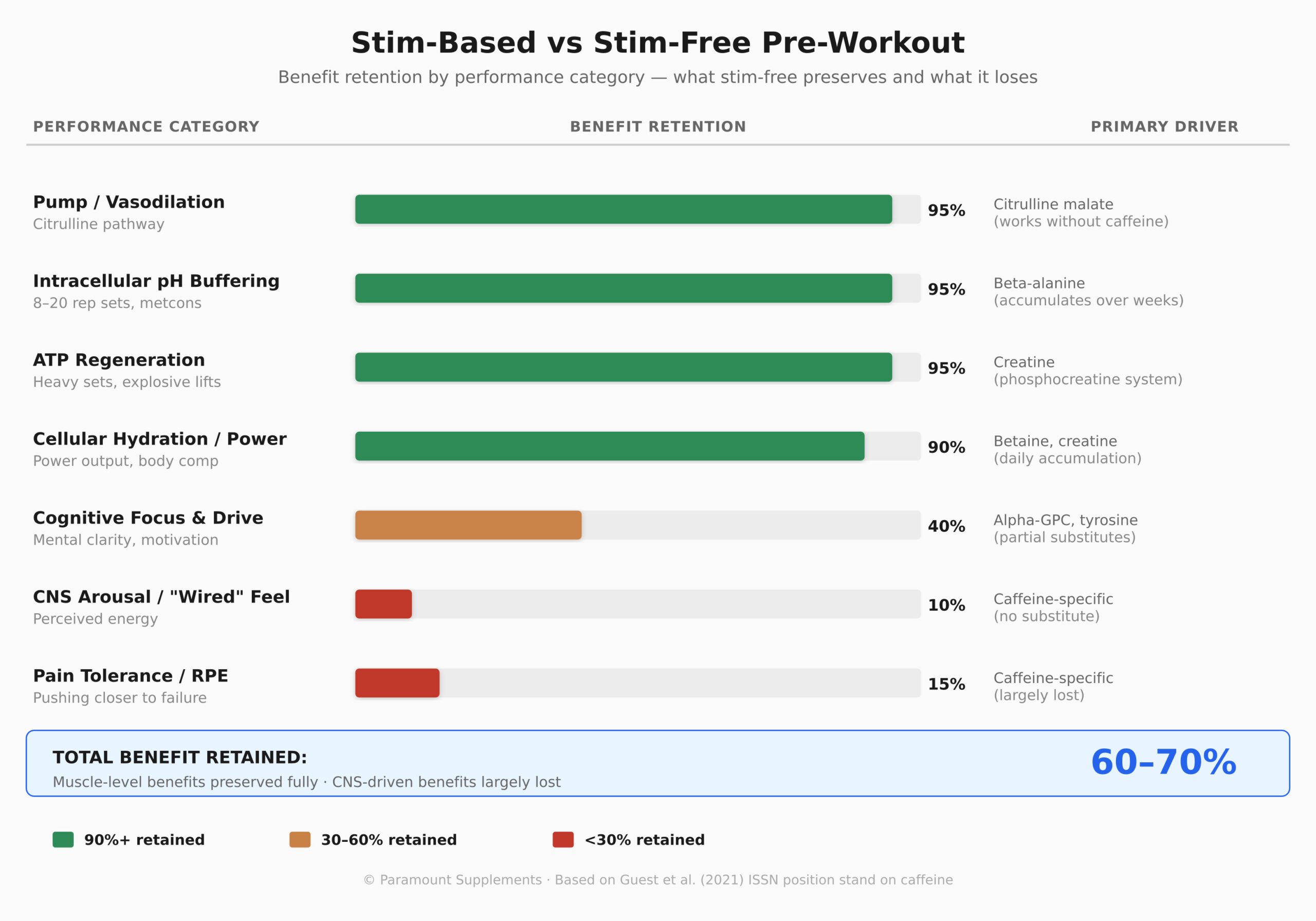
The honest version of what stim-free delivers, though, is different from the marketing. A well-formulated stim-free pre-workout captures roughly 60–70% of what a full stim-based formula provides — all of the pump, the pH buffering, the substrate support, and the cellular hydration. What it can’t replicate is the central nervous system arousal, the perceived energy, and the pain-tolerance edge that caffeine specifically produces. Understanding which side of that split matters to your training is what determines whether stim-free is right for you.
This guide is the framework. By the end, you’ll know exactly what stim-free formulas deliver, what they don’t, who benefits most, and what to look for on a label. Every claim is anchored to peer-reviewed evidence: ISSN position stands on caffeine, creatine, and beta-alanine, plus RCTs on the non-stimulant ingredients that do the actual work.
What “Stim-Free” Actually Means
A stim-free pre-workout is a pre-workout supplement formulated without caffeine and, in genuine versions, without any other central nervous system stimulants — no theacrine, no yohimbine, no DMHA, no synephrine, no hidden caffeine sources from green tea extract or guarana. The category exists because the active ingredients that drive most pre-workout performance benefits aren’t actually stimulants. They’re vasodilators, intramuscular buffers, and substrate-elevating compounds that work on the muscle cell directly rather than on the brain.
What Stays in the Formula
When you remove caffeine and other stimulants from a pre-workout, what remains is the entire vasoactive and intramuscular component of the standard pre-workout stack:
- Pump ingredients — citrulline malate, L-citrulline, agmatine, sometimes arginine or dietary nitrates. These work through the nitric oxide pathway to dilate blood vessels and support nutrient delivery to working muscle.
- Intramuscular buffers — beta-alanine for sustained capacity in high-intensity efforts, betaine for power output and cellular hydration.
- Substrates — creatine monohydrate for phosphocreatine regeneration during short, maximal efforts.
- Cognitive support without stimulants — alpha-GPC, L-tyrosine, L-theanine. These support focus through different mechanisms than caffeine — acetylcholine pathways, catecholamine precursors, attenuation of arousal — and work to varying degrees in the absence of caffeine’s synergy.
The Distinction From Pure “Pump Products”
A common confusion in the supplement aisle: some products marketed as “stim-free pre-workouts” are actually just pump products — single-purpose formulas built around citrulline, agmatine, and arginine without the buffering, substrate, or cognitive components. These work for the specific goal of vasodilation but don’t deliver the complete pre-workout effect a properly-formulated stim-free product provides. We’ll cover what a real ideal stim-free formula looks like in Section 7.
For the broader cluster context on how stim-free fits into the larger pre-workout ingredient hierarchy, see our complete pre-workout ingredients guide — this is the parent guide that covers every ingredient in both stim and stim-free formulations.
The Physiological Trade-Off
The most common mistake users make when trying stim-free pre-workout is expecting it to replicate the full experience of a caffeine-loaded formula. It doesn’t, and it can’t. Caffeine has a specific pharmacological profile — adenosine receptor antagonism producing CNS arousal — that isn’t replicable through any non-stimulant ingredient combination. Understanding exactly what’s gained and what’s lost makes the category much easier to evaluate.
What Stim-Free Pre-Workout Delivers
A well-formulated stim-free pre-workout delivers nearly all of the muscle-level benefits of a full stim-based formula:
- Vasodilation and pump — citrulline and agmatine work on the nitric oxide pathway independently of caffeine. The “pump” sensation during high-volume training is fully accessible without stimulants.
- Intracellular pH buffering — beta-alanine elevates muscle carnosine over weeks of consistent dosing regardless of whether caffeine is present in the formula. Sustained capacity in 1–4 minute efforts is preserved.
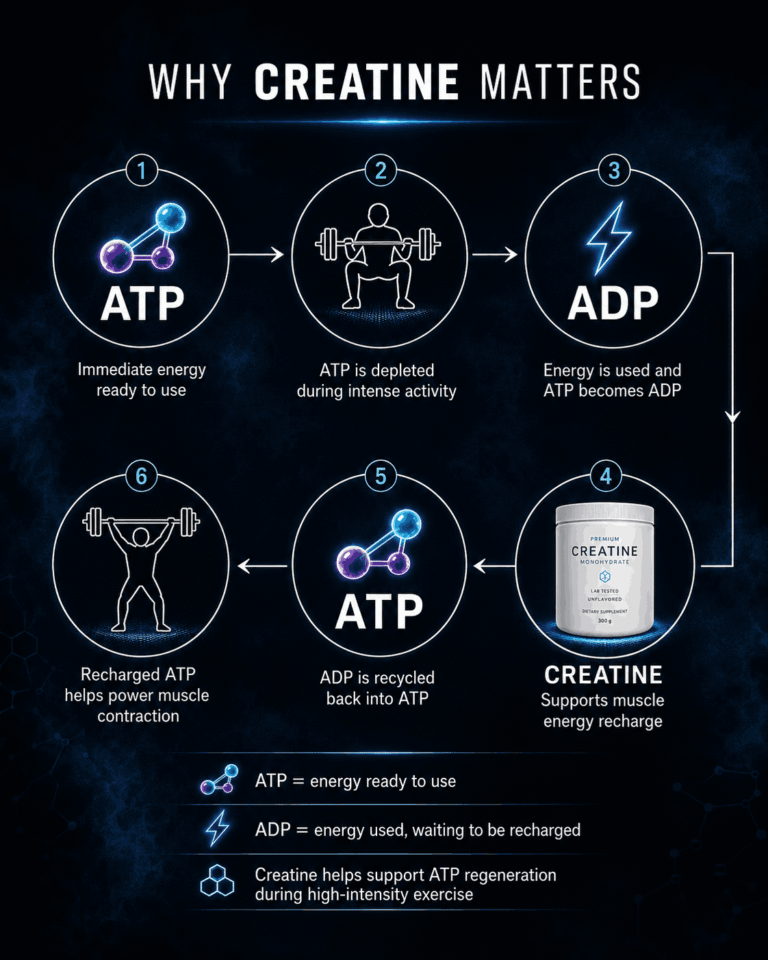
- ATP regeneration via phosphocreatine — creatine works the same way in stim-free formulas as in stim-based ones. Maximum-effort short-duration outputs benefit equally.
- Cellular hydration and power output — betaine accumulates over weeks regardless of stim status.
- Mild cognitive support — alpha-GPC, tyrosine, and theanine still produce measurable focus benefits, particularly in stressed or fatigued states. The effects are smaller than caffeine-driven focus, but real.
What Stim-Free Pre-Workout Doesn’t Deliver
The 2021 ISSN position stand on caffeine clearly identifies the categories of benefit that are caffeine-specific — meaning these are the categories where stim-free formulas underperform (Guest et al., 2021):
- Central nervous system arousal and perceived energy — the “wired” feeling most users associate with pre-workout. This is almost entirely caffeine’s mechanism, and no non-stimulant ingredient replicates it.
- Increased pain tolerance during training — caffeine modulates pain perception during exercise, allowing users to push closer to failure with less perceived discomfort. Stim-free formulas have no equivalent effect.
- Significant boost in 1RM strength — caffeine’s CNS drive translates directly to neural recruitment for maximum strength efforts. Stim-free formulas may help marginally through creatine and citrulline contributions, but the magnitude is smaller.
- Reduced perception of effort — the rate of perceived exertion at any given workload is consistently lower under caffeine. Stim-free training feels like the workload it actually is.
The Honest Expectation
Adding up the gains and losses, a properly-formulated stim-free pre-workout delivers approximately 60–70% of the total benefit of a full stim-based formula. Specifically: nearly 100% of the pump/vasodilation benefit, nearly 100% of the buffering and substrate benefits, and roughly 30–40% of the cognitive and arousal benefits. The trade-off is meaningful but bounded — it’s not a useless category, and it’s not a complete replacement.
Who Benefits Most From Stim-Free Pre-Workout
The audience for stim-free pre-workout is much broader than “people who don’t like caffeine.” Specific populations and training contexts where stim-free is the better choice — sometimes the only reasonable choice — span several distinct categories.
Evening and Late-Day Trainers
Caffeine has a half-life of roughly 5–6 hours in average metabolizers, longer in slow metabolizers. A 300 mg pre-workout dose taken at 6 PM still has 75–150 mg circulating at 11 PM bedtime — well within the range that disrupts sleep architecture in most people (Drake et al., 2013). Disrupted sleep, in turn, blunts the very training adaptations the pre-workout was meant to support. Stim-free pre-workout preserves training quality for evening sessions without paying a sleep cost. For lifters who train after work consistently, this is the highest-leverage use case in the entire category.
Caffeine-Sensitive Individuals
Slow caffeine metabolism is partly genetic — variants of the CYP1A2 enzyme dramatically affect how quickly caffeine clears from the bloodstream. Slow metabolizers experience longer-duration effects, more sleep disruption, and higher rates of caffeine-related anxiety and palpitations (Yang et al., 2010). For users who know they don’t tolerate caffeine well — diagnosed or otherwise — stim-free isn’t a preference, it’s a necessity. The same goes for users with anxiety disorders, heart palpitation history, or any cardiovascular condition where additional sympathetic activation is contraindicated.
Stimulant Cycling Users
Caffeine tolerance builds steadily with consistent daily use. Daily 400 mg pre-workout users often find the supplement stops “feeling” like much after 8–12 weeks. The most evidence-supported strategy for managing this is periodic deloads from caffeine — and stim-free pre-workout is the bridge that lets users maintain their training rituals and ingredient stack during a 1–2 week caffeine wash-out. Cycling between stim-based and stim-free phases is one of the most underrated practices for keeping caffeine effective long-term.
Specific Populations and Conditions
Several populations have specific reasons to avoid caffeinated pre-workout entirely:
- Pregnant and nursing athletes — public health guidance recommends limiting caffeine intake during pregnancy and nursing. Pre-workout-level caffeine doses (200–400 mg per serving) exceed those recommendations on their own, before counting daily coffee or other dietary caffeine. Stim-free is the appropriate option, but the underlying decision to supplement at all during pregnancy or nursing should be made with your physician.
- Adolescent athletes — caffeine dose calibration in growing athletes is genuinely unsettled territory. Stim-free formulas remove the variable, allowing access to the non-stimulant ingredients (creatine, beta-alanine, betaine, citrulline) that have established safety in this population.
- Shift workers — rotating sleep schedules make consistent caffeine timing nearly impossible to manage. Stim-free pre-workout decouples training stimulus from sleep risk for users on non-standard schedules.
- Hypertension or arrhythmia diagnoses — caffeine’s pressor and chronotropic effects can be contraindicated. Consult your physician for individualized guidance, but stim-free is the appropriate default if pre-workout is desired at all.
Tier S Stim-Free Ingredients
Without caffeine as the formula’s anchor, the burden shifts to the non-stimulant ingredients that have to deliver the full physiological benefit on their own. The Tier S ingredients in a stim-free context are the ones that produce measurable effects through muscle-level mechanisms, dosed at research-validated amounts.
Citrulline Malate (or L-Citrulline)
Citrulline is the single most important ingredient in a stim-free formula. Without caffeine carrying the formula on perceived energy and CNS drive, the pump and reduced-perceived-effort benefits from nitric oxide pathway activation have to do disproportionately more work. A 2010 trial showed that 8 g of citrulline malate produced an 18.5% increase in repetitions to failure across multiple sets of bench press (Pérez-Guisado & Jakeman, 2010). In a stim-free context, this effect is the formula’s primary performance driver.
Effective dose: 6–8 g citrulline malate or 3–6 g L-citrulline. For stim-free formulas, lean toward the upper end — 8 g citrulline malate or 5–6 g L-citrulline — to maximize the pump and endurance contribution.
Red flag: citrulline at 1–3 g per serving. At those doses, the pump benefit is marginal and you’re paying for a sub-effective ingredient.
Beta-Alanine
Beta-alanine works through accumulation of muscle carnosine over 10–12 weeks of consistent dosing, regardless of whether caffeine is present in the formula. Effective intracellular pH buffering during 1–4 minute high-intensity efforts is preserved fully in stim-free formulations (Trexler et al., 2015).
Effective dose: 4–6 g daily total. Per-serving in a stim-free pre-workout: 1.6–3.2 g, with the daily total supplemented from additional sources if needed. For the full mechanism, dosing protocols, and how to manage paresthesia, see our complete beta-alanine guide.
Creatine Monohydrate
Creatine works through saturation of the muscle phosphocreatine pool, fueling ATP regeneration during short, maximal efforts. Stim-free pre-workout is actually one of the cleanest vehicles for daily creatine intake — no caffeine to worry about, take it whenever convenient, daily consistency is what matters (Kreider et al., 2017).
Effective dose: 3–5 g daily. A stim-free pre-workout containing 5 g creatine per serving can serve as your entire daily creatine dose, simplifying the supplement stack. See our complete creatine guide for the full picture.
Betaine Anhydrous
Betaine has accumulated solid evidence over the past decade for power output, body composition, and cellular hydration benefits — effects that are subtle but real, and become more noticeable in stim-free formulas where caffeine’s larger effects aren’t masking them (Cholewa et al., 2013).
Effective dose: 2.5 g daily across 4–6 weeks of consistent supplementation. Most stim-free pre-workouts at the higher quality tier include betaine at 1.25–2.5 g per serving.
Alpha-GPC
Without caffeine to drive cognitive arousal, alpha-GPC becomes the primary cognitive support ingredient in stim-free formulas. The compound is a choline precursor that supports acetylcholine production, with established evidence for cognitive function and preliminary data on power output (Bellar et al., 2015).
Effective dose: 400–600 mg per serving in stim-free contexts — lean toward the upper end to compensate for the absence of caffeine’s focus contribution. Some products include alpha-GPC at 150–300 mg, which is sub-effective for the cognitive role it’s meant to play in stim-free formulas.
Tier A Stim-Free Add-Ons
The next tier of ingredients have decent evidence but earn their spot conditionally — when the audience or training context fits, when the dose is right, or as a meaningful contribution to specific outcomes. Here’s how each one stacks up in a stim-free context.
L-Tyrosine
Tyrosine is a precursor to catecholamines — dopamine, norepinephrine — the neurotransmitters involved in arousal and focus. In a stim-free context, tyrosine becomes a partial substitute for some of caffeine’s cognitive-driving effects, particularly under stressed or sleep-deprived conditions. The effect is smaller than caffeine’s, but it operates through a different mechanism (substrate availability for catecholamine synthesis rather than adenosine antagonism), so it has independent value.
Effective dose: 1.5–3 g per serving. Stim-free formulas should lean toward the upper end of this range to maximize the cognitive support. Products including 250–500 mg of tyrosine are sub-effective for any practical benefit.
L-Theanine
Theanine’s role shifts in stim-free formulas. In stim-based formulas, theanine is paired with caffeine to attenuate jitteriness while preserving focus benefits. Without caffeine, that synergy disappears, and theanine’s independent effect is smaller — modestly calming for anxious-prone users, with some preserved cognitive contribution.
Effective dose: 200–400 mg per serving. Worth including in stim-free formulas marketed to users prone to training anxiety; less essential otherwise.
Agmatine Sulfate
Agmatine is marketed for “pump” enhancement via nitric oxide pathway support and extended pump duration. Human RCT evidence remains limited — most agmatine data is mechanistic or animal-based, with sparse translation to clinical performance outcomes. The supplement isn’t harmful, but the specific benefits marketed haven’t materialized at the level seen with citrulline.
If your stim-free formula already has 6–8 g of citrulline malate at effective dose, agmatine adds little. If citrulline is at sub-effective amounts, agmatine isn’t going to make up the difference. Optional — not essential.
Beetroot and Dietary Nitrates
Beetroot juice and concentrated nitrate supplements raise plasma nitrate and nitrite, improving oxygen efficiency during sub-maximal aerobic exercise. The effective dose is 6–8 mmol nitrate (roughly 400–500 mg), taken 2–3 hours pre-exercise. The timing requirement makes it impractical to include in a “30 minutes before training” stim-free pre-workout — the formula’s other ingredients work best at 30 minutes pre, but beetroot needs the longer lead time.
Best used as a separate product taken with the longer lead time, rather than as part of the stim-free pre-workout matrix. Endurance-focused stim-free users benefit most from this combination.
What to Avoid in Stim-Free Formulas
Stim-free pre-workout has its own category-specific red flags beyond the general pre-workout warnings. Here’s what to scan for:
Hidden Caffeine Sources
Some “stim-free” products include green tea extract, guarana, yerba mate, kola nut, or other plant-based ingredients that contain caffeine — sometimes at substantial doses. A “stim-free” formula listing “green tea extract: 500 mg” can deliver 50–100 mg of caffeine without the label admitting it’s a stimulant product. Read every ingredient on the label and verify that no plant extract on the list contains caffeine. If you see green tea, guarana, kola nut, or yerba mate in a “stim-free” product, treat it as a stim-based product with a misleading label.
Proprietary “Pump Matrix” Blends
Same problem as standard pre-workouts. A “Pump Matrix: 5 g” containing citrulline, agmatine, and arginine mathematically cannot deliver an effective dose of citrulline (6–8 g alone) in that total. The blend exists to hide underdosing. Skip it. See our complete pre-workout ingredients guide for the full breakdown of why proprietary blends are the master red flag.
Underdosed Citrulline
This is the most common quality issue in the stim-free category. Citrulline is doing more of the heavy lifting in a stim-free formula than in any other context — and many products include it at 1–3 g per serving, well below the 6–8 g research dose. Without effective-dose citrulline, the stim-free formula isn’t really delivering its primary mechanism. Verify the citrulline dose before anything else.
Adaptogen Performance Blends
Some stim-free formulas include adaptogen stacks (ashwagandha, rhodiola, ginseng, holy basil) marketed for “performance support without stimulants.” The individual ingredients have legitimate stress-management evidence in their own right, but the marketed performance claims at typical pre-workout doses aren’t well-supported. These ingredients aren’t harmful, but they’re not stim-free essentials either.
Theacrine, DMHA, Yohimbine, Synephrine
None of these should ever appear in a stim-free formula. They’re all stimulants of various intensity. If you see any of them on a “stim-free” label, the product is mislabeled or deliberately misleading. Either way, walk away.
What an Ideal Stim-Free Formula Looks Like
Once you understand the ingredient hierarchy and effective doses, building a reference formula to compare products against becomes straightforward. Here’s what a quality stim-free pre-workout should contain per serving:
| Ingredient | Dose | Function |
|---|---|---|
| Citrulline Malate | 8 g | Vasodilation, pump, reduced perceived effort |
| Beta-Alanine | 3.2 g | pH buffering (toward 4–6 g daily target) |
| Creatine Monohydrate | 5 g | ATP regeneration, full daily dose |
| Betaine Anhydrous | 2.5 g | Power output, cellular hydration |
| Alpha-GPC | 600 mg | Cognitive focus, primary cognitive driver |
| L-Tyrosine | 1.5 g | Catecholamine support, partial caffeine substitute |
| Taurine | 1 g | Anti-fatigue, cellular hydration |
Total active ingredients per serving: roughly 21–22 g. This is significantly larger than a typical stim-based pre-workout scoop, which is unavoidable — without proprietary blends to hide quantities, an effective stim-free formula has to be physically larger to deliver evidence-based doses of every component.
Compare any product you’re considering against this reference. If it underdoses citrulline below 6 g, drops creatine below 3 g, or hides any ingredient in a proprietary blend, it’s compromised on what should be table stakes for the category.
DIY Stim-Free Stack
The DIY case for stim-free pre-workout is even stronger than for stim-based. Without caffeine — which is straightforward to dose accurately in any commercial product — the entire stim-free formula is muscle-level ingredients that benefit from precise dosing control. Here’s a representative DIY stack matching the ideal formula above:
- Citrulline malate — 8 g
- Beta-alanine — 3 g (one of 2–3 daily doses)
- Creatine monohydrate — 5 g
- Betaine anhydrous — 2.5 g
- Alpha-GPC capsule — 300–600 mg
- L-tyrosine — 1.5 g (optional, capsule or powder)
- Taurine — 1 g (optional)
Cost per serving at commodity pricing: $1.00–1.60 depending on whether you include alpha-GPC (more expensive per gram than the others). Monthly cost training 5 days/week: $20–35.
Compare to a premium stim-free pre-workout: $2.00–3.50 per serving, $40–90 per month. The convenience premium for stim-free is steeper than for stim-based products because the active ingredient cost is higher relative to flavoring and packaging — DIY saves more, proportionally.
The Honest Take
For users who train consistently and care about evidence-based dosing, the DIY stim-free stack is the better option on every metric except mixing convenience. Each ingredient is at its research-validated dose, fully transparent, and dramatically cheaper. For users who train sporadically or who value taste and convenience above dose precision, a well-formulated transparent-label stim-free product is reasonable — verify against the reference formula in Section 7 before buying.
Pre-Workout Cycling — Strategic Use of Stim-Free
Beyond the “I can’t tolerate caffeine” use case, stim-free pre-workout has strategic value as part of a broader caffeine management approach. Most lifters never consciously cycle their stimulant exposure, which is exactly why caffeine stops working for them after a few months of daily high-dose use.
Restoring Caffeine Sensitivity
Caffeine tolerance builds steadily with consistent daily exposure. The most evidence-supported strategy for restoring sensitivity is a 1–2 week complete caffeine wash-out every 8–12 weeks. During the wash-out, training quality benefits from continuing to use the non-stimulant ingredients of pre-workout — citrulline, beta-alanine, creatine, betaine. Stim-free pre-workout is the natural bridge that maintains your training ritual and ingredient stack during the wash-out phase. When you return to stim-based formulas, the same dose feels dramatically more effective.
Alternating Training Days
Another approach: stim-based pre-workout for heavy compound lift days where CNS drive matters most, stim-free for accessory work days where pump and buffering are the primary needs. This pattern preserves caffeine effectiveness for the sessions that benefit most while reducing total weekly caffeine exposure.
Pre-Deload Protocols
During deload weeks, the goal is recovery without sacrificing training ritual. Stim-free pre-workout maintains the psychological cue of a “real session” without the CNS load that competes with recovery processes. Users who deload with stim-free often report better sleep and faster recovery without the discipline difficulty of skipping pre-workout entirely.
Travel and Sleep-Disrupted Training
Time zone changes, overnight flights, irregular sleep schedules, and rotating shift work all create contexts where adding caffeine to an already-disrupted system makes the disruption worse. Stim-free pre-workout decouples training from sleep risk in these contexts, allowing consistent session quality without compounding the sleep cost.
Frequently Asked Questions
Does stim-free pre-workout actually work?
Yes, in specific physiological categories. A well-formulated stim-free pre-workout delivers nearly the full benefit of stim-based formulas for pump (citrulline), pH buffering (beta-alanine), substrate support (creatine), and cellular hydration (betaine). What it can’t replicate is the central nervous system arousal, perceived energy, and pain tolerance benefits that come specifically from caffeine. Expectation calibrated correctly, stim-free works for what it’s meant to do.
Is stim-free pre-workout as effective as regular pre-workout?
Roughly 60–70% as effective in total, but distributed unevenly. Stim-free preserves nearly 100% of the muscle-level benefits — pump, buffering, substrate — and roughly 30–40% of the cognitive and CNS benefits. For pump-focused training, hypertrophy work, and endurance contexts, the gap is small. For maximal strength singles or sessions where CNS drive matters most, the gap is larger.
What’s the best stim-free pre-workout ingredient?
Citrulline malate, by a wide margin. Without caffeine carrying the formula, the pump and reduced-perceived-effort benefits from nitric oxide pathway activation become the primary performance driver. A stim-free formula with 6–8 g of citrulline malate at effective dose can deliver meaningful training improvements. A stim-free formula with sub-effective citrulline is essentially marketing.
Can pregnant women take stim-free pre-workout?
Stim-free formulas avoid the caffeine restrictions that exclude stim-based pre-workouts during pregnancy. However, the broader question of supplementation during pregnancy involves individualized medical considerations beyond just the caffeine question — beta-alanine, citrulline, and other ingredients haven’t been studied in pregnant populations. Consult your physician before starting any supplement regimen during pregnancy or nursing.
Will stim-free pre-workout give me a pump?
Yes — and arguably better than many stim-based formulas. The pump effect comes primarily from citrulline-driven nitric oxide pathway activation, which works independently of caffeine. Stim-free formulas tend to dose citrulline at higher amounts than stim-based products (which often rely on caffeine to carry the formula’s overall feel), so the pure pump experience is often more pronounced.
Is stim-free pre-workout better for late-day training?
Yes. Caffeine has a 5–6 hour half-life, meaning a 300 mg pre-workout dose taken at 6 PM still has substantial caffeine circulating at 11 PM bedtime. Disrupted sleep blunts the very training adaptations the pre-workout was meant to support. For evening trainers, stim-free preserves training quality without the sleep cost.
Can I take stim-free pre-workout every day?
Yes. Unlike caffeine, the ingredients in stim-free formulas don’t build tolerance with consistent daily use — creatine, beta-alanine, and betaine actually work better with daily dosing because they accumulate over weeks. Stim-free pre-workout is one of the few pre-workout categories where daily use is unambiguously appropriate.
Does stim-free pre-workout help build muscle?
Indirectly, yes. By supporting more productive training sessions (more reps, better pump, sustained capacity), stim-free pre-workout contributes to the training volume that drives muscle growth. The accumulating ingredients (creatine, beta-alanine, betaine) also contribute directly to hypertrophy outcomes over months. It’s not a “muscle builder” in the direct sense, but it supports the training adaptations that build muscle.
Why does my “stim-free” pre-workout still have green tea extract?
Because green tea extract contains caffeine — typically 30–50 mg per 500 mg of extract. Some products use this loophole to deliver mild stimulant effects while marketing themselves as “stim-free” or “low-stim.” If you bought the product specifically to avoid caffeine, this matters. Read every ingredient on the label; if you see green tea extract, guarana, yerba mate, or kola nut, the product is not truly stim-free.
What’s the difference between stim-free pre-workout and pump products?
A stim-free pre-workout is a complete formula covering pump, buffering, substrate, and cognitive support without stimulants. A pump product is a single-purpose formula focused on vasodilation alone — typically citrulline, agmatine, sometimes arginine. Pump products work for the specific goal but don’t deliver the broader pre-workout experience. If you want comprehensive pre-workout support without caffeine, choose a well-formulated stim-free product, not just a pump supplement.
The Bottom Line
Stim-free pre-workout is a legitimate, evidence-backed category for a much broader audience than the “caffeine-sensitive” niche it’s usually marketed to. Evening trainers who can’t afford the sleep cost of pre-workout caffeine. Lifters cycling their caffeine exposure to preserve long-term effectiveness. Pregnant athletes, adolescent athletes, shift workers, and users with cardiovascular contraindications. For all of these populations, stim-free isn’t a compromise — it’s the right tool.
The honest framing matters. A well-formulated stim-free pre-workout delivers roughly 60–70% of the total benefit of a stim-based product, concentrated almost entirely in the muscle-level effects (pump, buffering, substrate). It doesn’t replicate CNS arousal, pain tolerance, or the “wired” feeling. Expectation set correctly, it works exactly as advertised.
For our tested shortlist of stim-free pre-workout products meeting every quality criterion, see our top picks for best stim-free pre-workout. For the broader cluster context, see our complete pre-workout ingredients guide, the performance supplements hierarchy, and the deep-dives on creatine and beta-alanine.
References
- Guest NS, VanDusseldorp TA, Nelson MT, et al. (2021). International Society of Sports Nutrition position stand: caffeine and exercise performance. Journal of the International Society of Sports Nutrition, 18(1):1. PMID: 33388079
- Kreider RB, Kalman DS, Antonio J, et al. (2017). International Society of Sports Nutrition position stand: safety and efficacy of creatine supplementation in exercise, sport, and medicine. Journal of the International Society of Sports Nutrition, 14:18. PMID: 28615996
- Trexler ET, Smith-Ryan AE, Stout JR, et al. (2015). International Society of Sports Nutrition position stand: beta-alanine. Journal of the International Society of Sports Nutrition, 12:30. PMID: 26175657
- Pérez-Guisado J, Jakeman PM (2010). Citrulline malate enhances athletic anaerobic performance and relieves muscle soreness. Journal of Strength and Conditioning Research, 24(5):1215–1222. PMID: 20386132
- Cholewa JM, Wyszczelska-Rokiel M, Glowacki R, et al. (2013). Effects of betaine on body composition, performance, and homocysteine thiolactone. Journal of the International Society of Sports Nutrition, 10(1):39. PMID: 23967897
- Bellar D, LeBlanc NR, Campbell B (2015). The effect of 6 days of alpha glycerylphosphorylcholine on isometric strength. Journal of the International Society of Sports Nutrition, 12:42. PMID: 26604824
- Drake C, Roehrs T, Shambroom J, Roth T (2013). Caffeine effects on sleep taken 0, 3, or 6 hours before going to bed. Journal of Clinical Sleep Medicine, 9(11):1195–1200. PMID: 24235903
- Yang A, Palmer AA, de Wit H (2010). Genetics of caffeine consumption and responses to caffeine. Psychopharmacology, 211(3):245–257. PMID: 20182501
- Waldron M, Patterson SD, Tallent J, Jeffries O (2018). The effects of an oral taurine dose and supplementation period on endurance exercise performance in humans: a meta-analysis. Sports Medicine, 48(5):1247–1253. PMID: 29546641
- Haskell CF, Kennedy DO, Milne AL, Wesnes KA, Scholey AB (2008). The effects of L-theanine, caffeine and their combination on cognition and mood. Biological Psychology, 77(2):113–122. PMID: 18006208
- Banderet LE, Lieberman HR (1989). Treatment with tyrosine, a neurotransmitter precursor, reduces environmental stress in humans. Brain Research Bulletin, 22(4):759–762. PMID: 2736402
- Kerksick CM, Wilborn CD, Roberts MD, et al. (2018). ISSN exercise & sports nutrition review update: research & recommendations. Journal of the International Society of Sports Nutrition, 15:38. PMID: 30068354