
Performance Supplements: An Evidence-Based Hierarchy (2026)
The global sports supplement industry pulled in over $45 billion last year, and a meaningful fraction of that money was spent on products that do nothing. Not “do nothing for some people” — do nothing for anyone, in any controlled trial, at any reasonable dose. This is the open secret of the supplement aisle: the regulatory bar is low, the marketing budgets are high, and the gap between what’s on the label and what’s actually in the bottle is wider than most consumers realize (Maughan et al., 2018).
This guide cuts through that. We’ve tiered every popular performance supplement on the market into a five-level hierarchy based on the strength and quantity of human evidence behind it. Tier S products work for almost everyone who trains. Tier D products are marketing theater you should actively avoid. Everything in between gets ranked by how confident the science actually is — not by how confidently it’s sold.
The framework is anchored to the consensus statements that matter: the International Olympic Committee’s position on dietary supplements for high-performance athletes, the International Society of Sports Nutrition’s exercise and sports nutrition review, and the individual position stands ISSN has published on creatine, caffeine, protein, beta-alanine, and others. Where the evidence is overwhelming, we say so plainly. Where it’s preliminary, we flag it. Where the supplement is a complete waste of money, we name it.
By the end of this guide, you’ll know exactly which supplements deserve a permanent spot in your stack, which ones make sense for specific goals, and which ones you can stop buying immediately.
How We Tiered These Supplements
Every supplement in this guide was scored against the same evidence pyramid — the same hierarchy researchers use when they assess the quality of any health claim. Not all studies are created equal, and the difference between a single 12-person trial and a meta-analysis pooling fifty randomized controlled trials is the difference between speculation and consensus.
The Evidence Pyramid
From strongest to weakest, the evidence we weighted looks like this:
- Meta-analyses and systematic reviews — multiple RCTs pooled and analyzed together, the gold standard for “does this work.”
- Randomized controlled trials (RCTs) — single human studies where subjects are randomly assigned to a supplement or placebo group.
- Position stands from major sports science bodies — ISSN, IOC, ACSM consensus documents that synthesize the available literature.
- Observational and cohort studies — useful for safety and population-level patterns, weaker for proving cause and effect.
- Mechanistic and animal studies — useful for explaining why something might work, but a positive result in rats or in a petri dish doesn’t mean a positive result in humans.
- Anecdote, testimonials, and marketing copy — not evidence. Counted as zero.
A supplement only earns a top-tier ranking when it has multiple meta-analyses, position-stand backing, and reproducible effect sizes across diverse populations. Promising mechanistic theories with no human RCTs land at the bottom of the pyramid, where they belong.
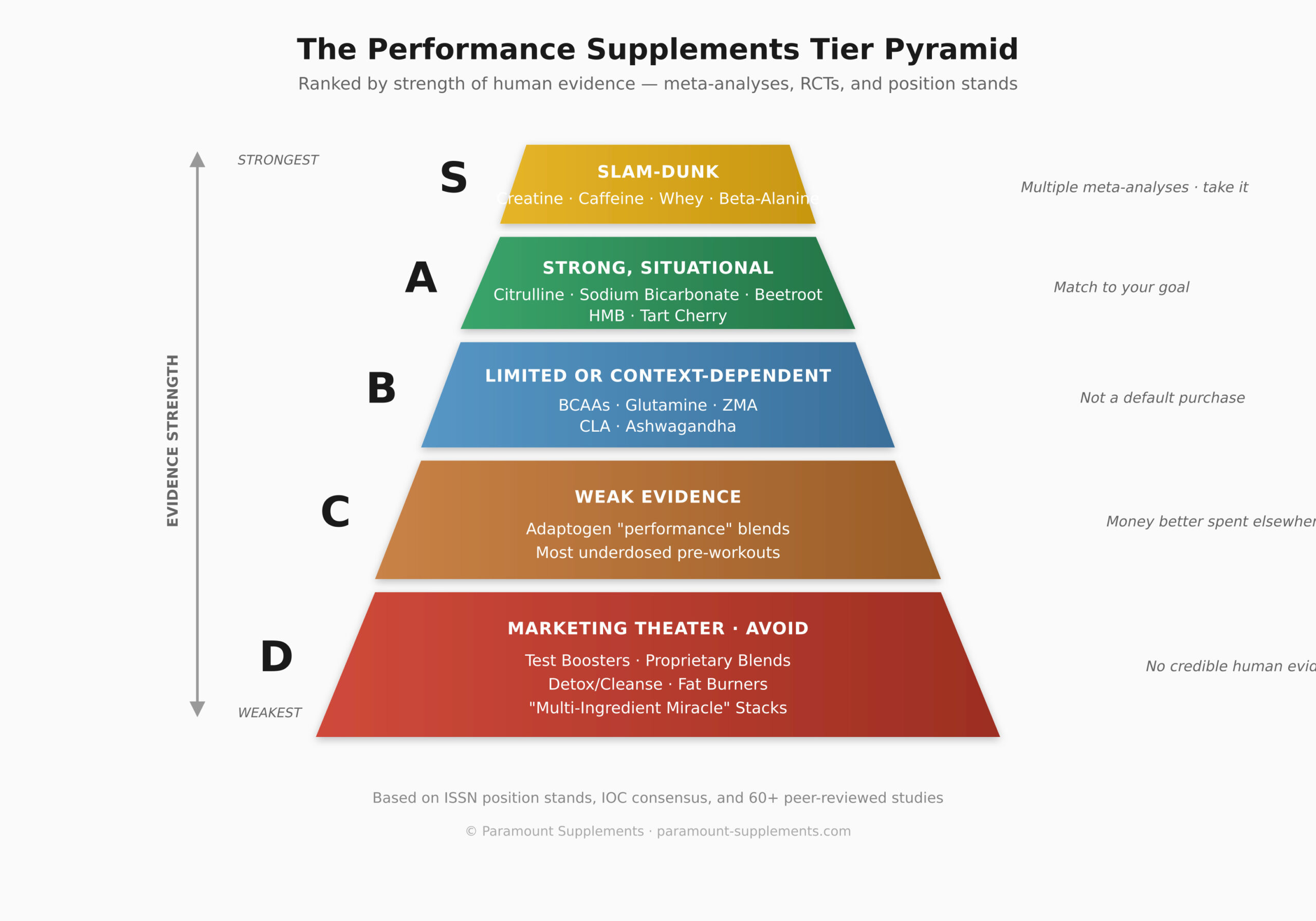
Our Five-Tier System
The tier list itself works like a video game tier list, with one important difference: nobody is selling you Tier D characters. Plenty of brands sell Tier D supplements every day.
| Tier | Evidence Profile | Practical Verdict |
|---|---|---|
| S | Multiple meta-analyses, replicated RCTs, position-stand backing, large effect sizes | Slam-dunk. Works for almost anyone who trains. Take it. |
| A | Strong RCT evidence in specific contexts; consistent effects within those contexts | Excellent for the right use case. Match to your goal. |
| B | Limited or context-dependent evidence; works only under specific conditions | Situational. Not a default purchase for most people. |
| C | Weak or contradictory human data; effect sizes small or inconsistent | Money better spent on Tier S and A products. |
| D | No credible human evidence, or evidence directly contradicting marketing claims | Marketing theater. Actively avoid. |
What This Framework Deliberately Excludes
Two categories sit outside this hierarchy on purpose. The first is general health and longevity supplements — vitamin D, omega-3, magnesium, fiber — which are worth taking for reasons that have nothing to do with performance in the gym. We touch on them briefly where they overlap with recovery and adaptation, but the focus of this guide is squarely on ergogenic aids: supplements that change what your body can do in a training session.
The second is banned substances and prescription compounds — anabolic steroids, SARMs, prohormones. These work. They also carry legal, ethical, and health risks that put them in an entirely different conversation than the legal, over-the-counter products covered here. We’re talking about supplements you can buy at your local nutrition shop and use without a needle, a prescription, or a doping violation.
What’s left, when you strip out those categories, is the universe of legal performance supplements actually sold to lifters, athletes, and weekend warriors. That’s what we tiered.
Tier S — Slam-Dunk Supplements
Tier S is the short list. Four supplements in the entire performance category clear the bar for “works in nearly everyone who trains, with effect sizes worth the cost, backed by overwhelming human evidence.” If you’re going to buy supplements at all, these are where the money goes first.
Creatine Monohydrate
Creatine is the most-studied supplement in sports nutrition history — more than 1,000 published trials, with effect sizes that have held up across thirty years of replication. A foundational meta-analysis pooling 22 controlled studies found that subjects supplementing creatine alongside resistance training gained roughly 8% more strength on average than those doing the same training without it (Rawson & Volek, 2003). The International Society of Sports Nutrition’s official position is that monohydrate is “the most effective ergogenic nutritional supplement currently available to athletes” — and they specifically name monohydrate, not the marketed alternatives (Kreider et al., 2017).
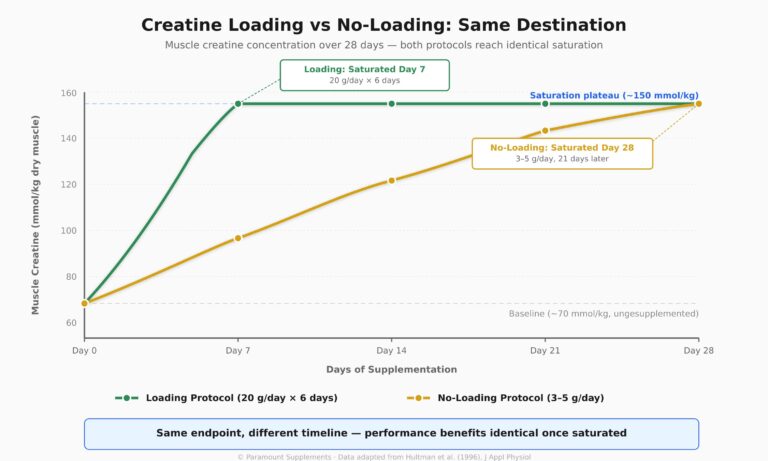
Dose: 3–5 g daily. Loading phase (20 g/day for a week) is optional and speeds saturation; the same plateau is reached in 3–4 weeks without loading.
Effect size: +8% strength, +1–2 kg lean mass over 4–12 weeks of training, measurable improvements in repeated-effort capacity.
For the full breakdown — mechanism, types, safety, dosing protocols, and brand selection — see our complete evidence-based creatine guide. The short version: buy plain monohydrate, ideally Creapure®, take it daily, and let saturation do the work.
Caffeine
Caffeine is the most-studied ergogenic compound in human history, full stop. The 2021 ISSN position stand on caffeine and exercise performance synthesized hundreds of trials and concluded that doses of 3–6 mg per kilogram of body weight taken 30–60 minutes before exercise reliably improve muscular endurance, strength, sprint performance, jumping, and even pain tolerance during training (Guest et al., 2021).
For an 80 kg lifter, that’s 240–480 mg — roughly two strong cups of coffee or a standard pre-workout serving. The effect is dose-dependent up to a ceiling, after which more caffeine produces more side effects (jitters, elevated heart rate, sleep disruption) without more performance.
Dose: 3–6 mg/kg, 30–60 minutes pre-training. Lower if caffeine-sensitive.
Effect size: Improvements typically range from 2–7% across strength, power, and endurance outcomes — modest in any single session, substantial when compounded across months of training.
One practical note: tolerance builds quickly. Cycling caffeine (lower doses on rest days, occasional 1–2 week deload) preserves the ergogenic effect. Daily 400 mg pre-workout users often find the supplement stops “feeling” like much after a few months — that’s tolerance, not the caffeine ceasing to work.
Whey and Casein Protein
Protein supplements aren’t magic. They’re a convenient way to hit a daily protein target that the research consistently links to lean mass and strength outcomes. The most comprehensive meta-analysis on the topic — Morton and colleagues pooling 49 RCTs — found that protein supplementation produced significant additional gains in fat-free mass and 1RM strength on top of resistance training, with diminishing returns above roughly 1.6 g per kilogram of body weight per day from total dietary intake (Morton et al., 2018).
Whey absorbs quickly and spikes muscle protein synthesis post-training. Casein digests slowly and provides a longer amino acid release — useful pre-bed or between long gaps between meals. Both work. The form matters far less than hitting your total daily target.
Dose: Whatever brings your total daily protein intake to 1.6–2.2 g/kg body weight. For most lifters, that’s 25–40 g per supplemented serving, 1–2 times daily.
Effect size: +27% improvement in resistance training-induced lean mass gain in trained populations versus training alone (Morton et al. meta-analysis).
The supplement-quality landscape is similar to creatine: look for third-party testing (Informed Sport, NSF), transparent labels with no proprietary “protein matrix” obfuscation, and skip the flavor-of-the-month formulations with twelve unnecessary added ingredients.
Beta-Alanine
Beta-alanine works by elevating muscle carnosine, which acts as an intracellular pH buffer during high-intensity work. The ISSN position stand on beta-alanine concluded that supplementation produces meaningful performance improvements in exercise lasting 60 seconds to 4 minutes — the time domain where lactic acid accumulation and pH drop become rate-limiting (Trexler et al., 2015).
That covers a lot of training: heavy sets of 8–20 reps, CrossFit-style metcons, 400–1500m running, repeated sprint protocols, combat sport rounds. It doesn’t help maximal strength singles (too short) or marathon pacing (too long and aerobic).
Dose: 4–6 g daily, split into smaller doses (1.5–2 g) to minimize paresthesia — the harmless tingling sensation many users experience.
Effect size: Roughly 2–3% improvement in high-intensity exercise capacity in the 1–4 minute range, building over 4–10 weeks of consistent supplementation as muscle carnosine accumulates.
For the full mechanism breakdown, dosing protocols, and how beta-alanine stacks with creatine and caffeine, see our forthcoming beta-alanine deep dive.
Tier A — Strong Evidence, Specific Use Cases
Tier A supplements have solid research behind them, but their effects are tied to specific contexts. They aren’t universal additions to every stack — they earn their spot when your goals or training style line up with what they actually do. Match the supplement to the use case and these are excellent investments. Throw them in without context and you’re paying for an effect you won’t measure.
Citrulline Malate
L-citrulline elevates plasma arginine and nitric oxide more effectively than supplemental arginine itself, supporting blood flow and reducing perceived effort during repeated-set training. A 2010 trial showed an 18.5% increase in repetitions to failure across multiple sets of bench press after a single dose of 8 g citrulline malate (Pérez-Guisado & Jakeman, 2010). Subsequent trials have been more variable, but the bodybuilding-style “more reps per set” use case has decent support.
Best for: Hypertrophy training, high-volume protocols, anyone doing 3+ sets to or near failure on the same exercise. Dose: 6–8 g, 30–60 minutes pre-training.
Sodium Bicarbonate
An extracellular pH buffer that works on the same physiological principle as beta-alanine but on a different timescale — acute, dose-dependent, used as needed rather than saturated over weeks. Bicarbonate consistently improves performance in 1–7 minute high-intensity efforts: 400m–1500m running, 100–400m swimming, rowing 2K, repeated sprints.
Best for: Track athletes, swimmers, combat sport athletes, CrossFit competitors. Dose: 0.2–0.3 g/kg body weight, taken 60–90 minutes before competition. GI distress is the limiting side effect — practice the protocol in training, not on race day.
Beetroot and Dietary Nitrates
Beetroot juice (and nitrate concentrate equivalents) raise plasma nitrate and nitrite, improving oxygen efficiency during sub-maximal aerobic exercise. A 2017 meta-analysis pooling 26 RCTs found significant improvements in time-to-exhaustion and time-trial performance, particularly in moderately trained athletes (Domínguez et al., 2017). Highly trained endurance athletes see smaller effects — their physiology is already highly optimized.
Best for: Recreational to moderately trained endurance athletes, cyclists, runners. Dose: 6–8 mmol nitrate (roughly 400–500 mg), 2–3 hours pre-exercise. Acute dosing works; chronic loading produces slightly larger effects.
HMB (Beta-Hydroxy Beta-Methylbutyrate)
HMB is a leucine metabolite that appears to attenuate muscle protein breakdown. The evidence is real but narrow: it works best in untrained populations, during caloric deficits, and in periods of intense training stress where muscle catabolism risk is elevated. Trained lifters in a normal caloric maintenance state see minimal benefit beyond what protein intake alone provides.
Best for: Cutting phases with high training volume, new lifters in their first months of training, older adults building muscle. Dose: 3 g daily, split into 1 g doses with meals.
Tart Cherry
Tart cherry concentrate has accumulated solid evidence for reducing post-exercise muscle soreness and accelerating recovery from eccentric-heavy training. It also modestly supports sleep quality via small naturally-occurring melatonin content — a useful adjunct for athletes whose training already disrupts sleep.
Best for: High-volume training blocks, competition tapers, athletes with sleep issues. Dose: 8–12 oz tart cherry juice or equivalent concentrate, 1–2 times daily during high-stress training periods.
Tier B — Situational or Limited Evidence
Tier B is where the marketing tends to outrun the science. These supplements aren’t useless — most of them have at least some evidence in some context — but the gap between what the label promises and what the trials actually show is wide enough that most consumers would be better served putting the money toward Tier S or A products.
BCAAs (Branched-Chain Amino Acids)
BCAAs are leucine, isoleucine, and valine — three of the nine essential amino acids. The marketing pitch is that they directly stimulate muscle protein synthesis during and after training. The science: yes, they do, but the effect is dramatically smaller than a complete protein source, and it only matters meaningfully if your total daily protein intake is too low to begin with. For a lifter already eating 1.6–2.2 g/kg of protein daily, BCAA supplementation adds essentially nothing measurable to muscle protein synthesis or hypertrophy outcomes (Wolfe, 2017).
Verdict: If your daily protein is dialed in, BCAAs are redundant. If your protein intake is low, fix that first with whey or food — you’ll get the BCAAs plus everything else.
Glutamine
Glutamine has well-documented benefits in clinical contexts — critical illness, severe burns, gut barrier dysfunction. In healthy athletes with adequate protein intake, controlled trials have consistently failed to show meaningful effects on muscle growth, recovery, or immune function at the doses sold in the supplement aisle.
Verdict: Skip unless a clinician recommends it for a specific medical context.
ZMA (Zinc, Magnesium, B6)
ZMA’s marketing leans heavily on early trials showing testosterone elevation in subjects who were zinc and magnesium deficient. The supplement works exactly as well as you’d expect: correcting a deficiency restores normal function. In subjects with normal mineral status, ZMA produces no meaningful changes in testosterone, strength, or body composition.
Verdict: If you have measured zinc or magnesium deficiency, supplement those minerals directly. Otherwise, the ZMA branding is paying for a story you don’t need.
CLA (Conjugated Linoleic Acid)
Marketed aggressively for fat loss and body composition. Human trials produce small, inconsistent effects — far smaller than even modest dietary changes — and the supplement has been associated with adverse effects on insulin sensitivity and inflammatory markers in some studies.
Verdict: Money better spent elsewhere.
Ashwagandha
One of the more interesting Tier B supplements because the evidence is genuinely accumulating. Multiple RCTs now suggest ashwagandha can reduce cortisol, modestly improve perceived stress, and may support sleep quality. Performance and hypertrophy effects are smaller and more variable. We’d watch this category over the next few years — it may well move up.
Verdict: Reasonable to try at 300–600 mg KSM-66 daily if stress management or sleep is your bottleneck. Don’t expect strength gains as a primary outcome.
Tier C and D — Marketing Theater & Active Avoids
The bottom of the pyramid is where most of the supplement industry’s profit margin lives. Tier C and D products either fail to demonstrate effects in controlled trials, sell mechanistic theories without human evidence, or actively rely on labeling tricks to hide how little active ingredient they contain. We’re naming them explicitly because polite hedging in this category isn’t honesty — it’s letting the marketing win.
Natural Test Boosters
Tribulus terrestris, D-aspartic acid (DAA), fenugreek extracts, “ZMA-stack” reformulations — the entire over-the-counter testosterone-boosting category. Controlled human trials have repeatedly failed to show meaningful, sustained testosterone elevation in healthy adult men at supplement-realistic doses. The small effects that do appear in some trials are typically transient (returning to baseline within weeks) and clinically meaningless. Tier D.
“Pump” Pre-Workouts With Proprietary Blends
If a pre-workout label lists “Mega Pump Matrix: 6 g” followed by ten ingredients without individual doses, you’re being sold a story. Effective doses of citrulline (6–8 g), beta-alanine (3–5 g per serving), and creatine (3–5 g) cannot mathematically fit inside a 6 g total — let alone alongside seven other “ingredients.” Proprietary blends exist primarily to hide underdosing. Tier D.
Detox, Cleanse, and “Fat Burner” Products
The human body has dedicated organs for detoxification: the liver and kidneys, both of which work continuously without supplementation. “Fat burner” stacks that aren’t simply caffeine + a stimulant are typically Tier D — green tea extract, raspberry ketones, garcinia cambogia, and similar ingredients have effect sizes so small they’re indistinguishable from placebo in controlled trials. Tier D.
Adaptogen Blends Marketed for Performance
Many adaptogens (ashwagandha, rhodiola) have legitimate stress-management evidence in their own right — we covered ashwagandha in Tier B. The Tier C/D versions are the marketed “performance blends” that combine eight adaptogens at sub-effective doses and promise everything from strength gains to libido enhancement. Tier C.
“Multi-Ingredient Miracle” Supplements
Any product whose marketing claims it does five or more unrelated things — builds muscle, burns fat, boosts test, improves sleep, enhances focus, supports joint health — is almost certainly a Tier D product. Real ergogenic effects come from specific compounds working through specific mechanisms at specific doses. Anything claiming to do everything is selling marketing copy, not science.
Stack Recommendations by Goal
The right stack depends on what you’re training for. A powerlifter, a CrossFit athlete, an endurance cyclist, and a recreational lifter who wants to look better at the beach all benefit from different combinations of the supplements above. Below are five practical loadouts, each built from Tier S and Tier A products only — no waste, no theater.
| Goal | Core Stack | Optional Add-Ons |
|---|---|---|
| Strength & Hypertrophy | Creatine + Whey + Caffeine | Citrulline malate (hypertrophy phases), HMB (cutting phases) |
| Endurance (Running, Cycling) | Caffeine + Beetroot + Whey | Sodium bicarbonate (race day, <7 min efforts), Tart cherry (heavy training blocks) |
| HIIT, CrossFit, Team Sports | Creatine + Caffeine + Beta-Alanine | Sodium bicarbonate (competition), Whey (recovery) |
| Recovery & Adaptation | Whey + Creatine + Tart Cherry | Ashwagandha (high-stress periods), Magnesium |
| General Health + Light Training | Creatine + Whey | Vitamin D, Omega-3 (health stack, not strictly ergogenic) |
Strength and Hypertrophy
Creatine builds the saturation that lets you train harder. Whey gets you to your daily protein target. Caffeine sharpens the focus and increases work capacity in the session. That’s the entire essential stack for 95% of lifters chasing more muscle and more strength — total cost under $30/month if you’re not buying premium-branded versions of commodity ingredients.
Endurance Athletes
Caffeine remains the highest-leverage ergogenic for nearly every endurance sport. Beetroot adds an oxygen-efficiency edge that’s especially valuable for moderately-trained athletes. Whey supports protein turnover under the high training volumes endurance sport demands. Sodium bicarbonate enters the picture for race-day events under seven minutes.
HIIT, CrossFit, and Team Sports
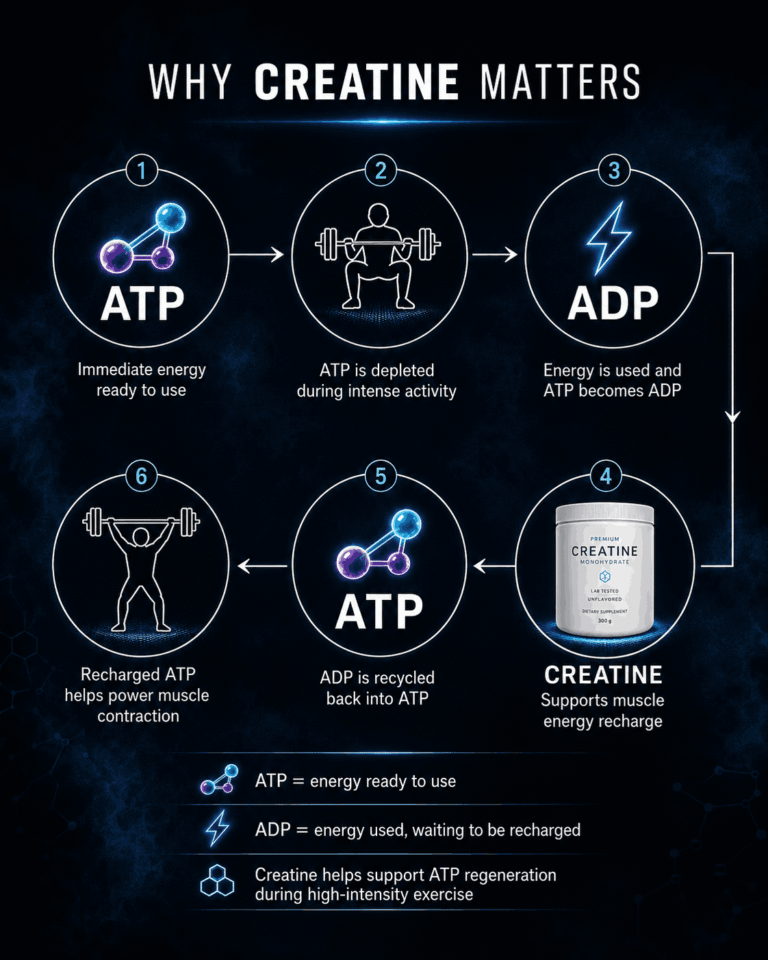
This is where Tier S really shines because three of the four members directly address the demands of repeated high-intensity efforts. Creatine for the phosphocreatine system, caffeine for central nervous system drive, beta-alanine for intracellular pH buffering during 1–4 minute efforts. This stack is the cleanest example in the entire guide of supplements matching physiology.
Recovery and Adaptation
For athletes managing high training stress — multiple sessions per day, periodized competition prep, accumulated fatigue — the recovery stack shifts emphasis from acute performance to longer-term adaptation. Tart cherry supports sleep and reduces soreness. Ashwagandha (Tier B but reasonable here) helps with cortisol management during prolonged high-stress phases.
General Health Foundation
For the lifter or athlete who trains 3–4 times per week without competitive goals, the entire essential stack is two products: creatine and whey. Adding vitamin D and omega-3 — both more about general health than performance — fills out a complete foundation. Anything beyond that is optimization, not necessity.
Building Your Practical Stack
The supplement industry would prefer you stack ten products. The research suggests three to five is the right zone for almost everyone — and the diminishing returns past that point are steep. Here’s how we’d recommend you actually build, in priority order:
Food First, Supplements Second
This isn’t a polite disclaimer. No supplement compensates for chronic under-eating, inadequate protein, poor sleep, or insufficient training stimulus. We’ve seen lifters spend $200/month on supplements while eating 80 g of protein and sleeping six hours a night, then wonder why nothing works. Fix the fundamentals first — total calories, protein at 1.6–2.2 g/kg, 7+ hours of sleep, consistent training program — and then supplements compound the results you’ve already earned.
Start With Tier S, Period
If you’re new to supplementation, start with creatine alone. Three weeks in, add a quality whey if you’re not hitting protein targets through food. A month after that, add caffeine pre-training if you train hard enough to want it. Beta-alanine slots in last, and only if your training includes 1–4 minute high-intensity work. This sequence lets you actually notice each supplement’s effect — adding everything at once means attributing nothing.
Add Tier A by Goal, Not by Default
Tier A products earn their spot in your stack when your training matches their use case — citrulline for hypertrophy blocks, beetroot for endurance racing, bicarbonate for sub-7-minute competitive efforts, HMB for cutting phases. Random Tier A supplementation without a matching context is money spent on effects you won’t measure.
Don’t Stack More Than Five Active Supplements
Past four or five products, you stop being able to attribute effects to any single one. Side effects compound, costs add up, and the marginal benefit of supplement number six is almost always smaller than what you’d get from one more weekly training session or 30 more grams of daily protein. Discipline in the supplement aisle is a form of training discipline.
Budget Reality Check
A complete Tier S stack — creatine, whey, caffeine, beta-alanine — costs $25–40 per month at commodity pricing. A complete Tier S + targeted Tier A stack runs $40–70 per month. Anyone spending over $100/month on supplements is either an elite competitive athlete optimizing the last 1%, or being marketed to. There’s no middle ground.
Red Flags When Buying Supplements
Once you know which supplements work, the next challenge is buying versions of those supplements that actually contain what they claim to contain, at the dose they claim to contain it. The supplement industry’s regulatory environment makes this less straightforward than it should be. Here’s what to scan for on the label:
Proprietary Blends
The single biggest red flag in the supplement aisle. A “proprietary blend” lists multiple ingredients followed by a single total weight, hiding the individual dose of each one. There is only one reason brands use proprietary blends: to disguise underdosing. If a pre-workout label shows “Energy Matrix: 4 g” containing caffeine, citrulline, beta-alanine, and creatine, mathematically those ingredients cannot all be at effective doses. Walk away.
Underdosed Active Ingredients
Even outside proprietary blends, many supplements include token amounts of trendy ingredients well below the doses used in research. 1 g of citrulline in a “pump” pre-workout (research dose: 6–8 g). 500 mg of beta-alanine (effective: 3–5 g per serving). 200 mg of ashwagandha (research doses typically 300–600 mg KSM-66). If the label dose is dramatically below what the actual evidence used, the active ingredient is a marketing decoration, not an effective dose.
Marketing Claims Without Citations
“Boosts performance.” “Accelerates recovery.” “Maximizes gains.” Any product making strong claims should be able to point to actual human research on the actual ingredient at the actual dose in the product. Most can’t, which is why the strongest marketing copy lives on the products with the weakest evidence behind them.
No Third-Party Testing
Independent testing is the only assurance you have that what’s in the bottle matches what’s on the label. The main programs worth knowing:
- Informed Sport — tests every batch for banned substances and label accuracy. The strictest program.
- NSF Certified for Sport — similar batch-level banned-substance testing, widely respected.
- USP Verified — focuses on ingredient identity, potency, and contamination, less athlete-specific.
- Creapure® — specific to creatine monohydrate; the gold-standard raw material, German-manufactured and purity-tested.
If you’re a competing athlete subject to drug testing, third-party certification isn’t optional — contaminated supplements have ended careers. For non-competing consumers, it’s still a meaningful trust signal that the brand cares about what’s actually in the product.
Frequently Asked Questions
Do I really need supplements to make progress?
No. Supplements are optimization, not foundation. A lifter eating sufficient protein, training consistently, and sleeping adequately will build significant strength and muscle without any supplementation at all. Tier S products like creatine and whey accelerate the rate of progress and make hitting daily nutrition targets more convenient — but they don’t substitute for the fundamentals.
Are performance supplements safe?
The Tier S products — creatine, caffeine, whey, beta-alanine — have extensive long-term safety data in healthy adults at standard doses. Tier A products are generally well-tolerated when used appropriately. Tier C and D products vary widely; some are merely ineffective, while others (particularly some “test boosters” and stimulant-heavy fat burners) carry real risks. The safer path is to stick with Tier S and A products from third-party-tested brands.
Are supplements regulated by the FDA?
In the United States, dietary supplements are regulated more loosely than pharmaceuticals or food. The FDA does not pre-approve supplements for safety or efficacy — brands self-certify before going to market, and enforcement happens primarily after problems arise. This is why third-party testing programs like Informed Sport and NSF Certified for Sport carry real weight: they provide the independent verification regulators don’t.
Can I just eat food instead of taking supplements?
For most products, partially yes — but with practical limits. You can theoretically eat enough red meat and fish to saturate muscle creatine stores, but it would mean eating about two pounds of beef daily. You can hit your protein target through food alone, but a whey shake replaces 30 g of protein in 90 seconds. Supplements are convenience and concentration. Whether they’re worth the cost depends on how realistic the food-only equivalent actually is for your life.
Are pre-workout supplements dangerous?
Pre-workouts built around evidence-based ingredients at sensible doses — caffeine in the 200–400 mg range, beta-alanine, citrulline, creatine — are well-tolerated in healthy adults. The risk shifts when products combine multiple stimulants (caffeine + yohimbine + DMHA-style compounds), use proprietary blends to hide doses, or include un-tested novel stimulants. Stick to transparent-labeled, third-party-tested products at standard doses and the safety margin is wide.
Do natural supplements work better than synthetic ones?
No. “Natural” and “synthetic” are marketing categories, not pharmacological ones. Creatine monohydrate is the same molecule whether it’s manufactured in a German chemical facility or extracted from animal flesh — your body cannot tell the difference. What matters is purity, dose, and bioavailability, all of which are independent of the “natural” branding.
What’s the most effective supplement for muscle growth?
Creatine monohydrate, by a wide margin, for sheer evidence-to-effect ratio. Adequate total protein intake (often supported by whey supplementation) matters more in absolute terms, but creatine is the supplement that produces the most reliable additional gain on top of training and adequate protein. No other legal supplement comes close.
Are stim-free pre-workouts just as effective?
It depends on what you want from a pre-workout. If you’re after the focus and central nervous system drive that caffeine provides, no — stim-free pre-workouts lack that component. If you’re after the pump, performance, and buffering effects from citrulline, beta-alanine, and creatine, a well-formulated stim-free product delivers nearly the same physiological benefits without the caffeine. Many lifters who train at night or are caffeine-sensitive find stim-free formulations a better fit.
Do I need to cycle supplements?
For most supplements, no. Creatine doesn’t need cycling. Whey doesn’t need cycling. Beta-alanine doesn’t need cycling. The main exception is caffeine, where tolerance builds with consistent high-dose use — cycling lower doses on rest days and taking occasional 1–2 week deloads preserves the ergogenic effect. Cycling other supplements is generally a holdover from steroid-era thinking that doesn’t apply to the legal ergogenic category.
The Bottom Line
The performance supplement industry will sell you anything. Tier S sells itself because the science is overwhelming. Tier D sells because the marketing is overwhelming. Most of the products in between depend on which voice you listen to — the lab or the label.
The framework above is the version we wish more lifters had when they were starting out: a clear, honest hierarchy of what’s worth the money, what’s worth the money sometimes, and what’s not worth the money ever. Build your stack from the top. Match Tier A products to your actual training goals. Spend the money you save on better food, better sleep, and more sessions in the gym. The supplements that work, work because they support those fundamentals — they don’t replace them.
For deep dives on the highest-leverage Tier S products, start with our complete evidence-based creatine guide. Cornerstone deep-dives on caffeine, whey, and beta-alanine are coming next in the cluster.
References
- Maughan RJ, Burke LM, Dvorak J, et al. (2018). IOC consensus statement: dietary supplements and the high-performance athlete. British Journal of Sports Medicine, 52(7):439–455. PMID: 29540367
- Kerksick CM, Wilborn CD, Roberts MD, et al. (2018). ISSN exercise & sports nutrition review update: research & recommendations. Journal of the International Society of Sports Nutrition, 15:38. PMID: 30068354
- Kreider RB, Kalman DS, Antonio J, et al. (2017). International Society of Sports Nutrition position stand: safety and efficacy of creatine supplementation in exercise, sport, and medicine. Journal of the International Society of Sports Nutrition, 14:18. PMID: 28615996
- Rawson ES, Volek JS (2003). Effects of creatine supplementation and resistance training on muscle strength and weightlifting performance. Journal of Strength and Conditioning Research, 17(4):822–831. PMID: 14636102
- Guest NS, VanDusseldorp TA, Nelson MT, et al. (2021). International Society of Sports Nutrition position stand: caffeine and exercise performance. Journal of the International Society of Sports Nutrition, 18(1):1. PMID: 33388079
- Morton RW, Murphy KT, McKellar SR, et al. (2018). A systematic review, meta-analysis and meta-regression of the effect of protein supplementation on resistance training-induced gains in muscle mass and strength in healthy adults. British Journal of Sports Medicine, 52(6):376–384. PMID: 28698222
- Trexler ET, Smith-Ryan AE, Stout JR, et al. (2015). International Society of Sports Nutrition position stand: beta-alanine. Journal of the International Society of Sports Nutrition, 12:30. PMID: 26175657
- Pérez-Guisado J, Jakeman PM (2010). Citrulline malate enhances athletic anaerobic performance and relieves muscle soreness. Journal of Strength and Conditioning Research, 24(5):1215–1222. PMID: 20386132
- Domínguez R, Cuenca E, Maté-Muñoz JL, et al. (2017). Effects of beetroot juice supplementation on cardiorespiratory endurance in athletes: a systematic review. Nutrients, 9(1):43. PMID: 28067808
- Wolfe RR (2017). Branched-chain amino acids and muscle protein synthesis in humans: myth or reality? Journal of the International Society of Sports Nutrition, 14:30. PMID: 28852372
- Wilson JM, Lowery RP, Joy JM, et al. (2014). The effects of 12 weeks of beta-hydroxy-beta-methylbutyrate free acid supplementation on muscle mass, strength, and power in resistance-trained individuals. European Journal of Applied Physiology, 114(6):1217–1227. PMID: 24599749
- Howatson G, Bell PG, Tallent J, et al. (2012). Effect of tart cherry juice (Prunus cerasus) on melatonin levels and enhanced sleep quality. European Journal of Nutrition, 51(8):909–916. PMID: 22038497
- Carbone JW, Pasiakos SM (2019). Dietary protein and muscle mass: translating science to application and health benefit. Nutrients, 11(5):1136. PMID: 31121843
- Hobson RM, Saunders B, Ball G, et al. (2012). Effects of β-alanine supplementation on exercise performance: a meta-analysis. Amino Acids, 43(1):25–37. PMID: 22270875
- Carr AJ, Hopkins WG, Gore CJ (2011). Effects of acute alkalosis and acidosis on performance: a meta-analysis. Sports Medicine, 41(10):801–814. PMID: 21923200