Creatine Loading Phase: Myth or Necessary? (2026)
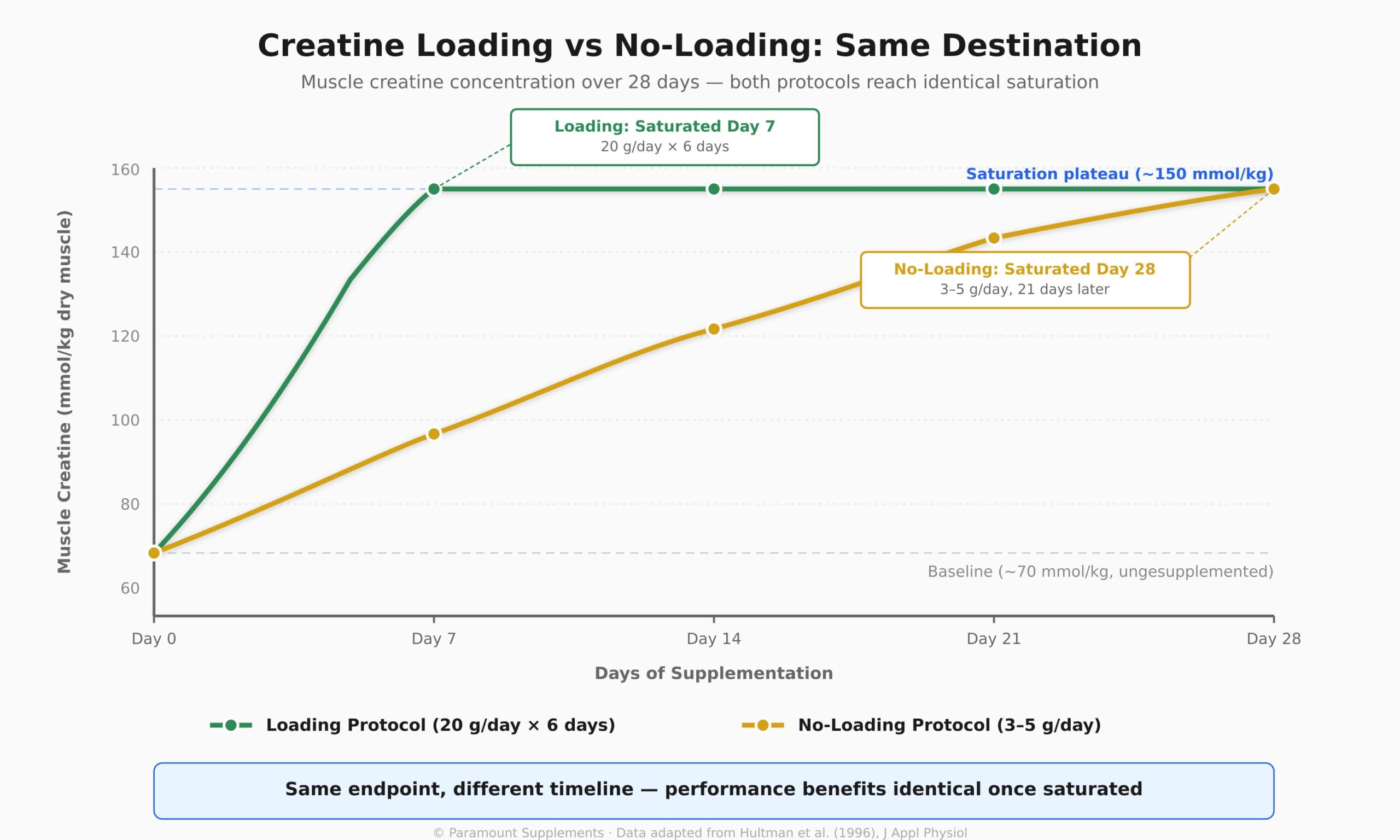
In 1996, a Swedish exercise physiology lab published a six-day study that would shape supplement marketing for the next three decades. Six healthy men consumed 20 grams of creatine daily for six days. Muscle biopsies showed that creatine concentrations rose to a saturation plateau within a week — a finding that became the basis for nearly every “creatine loading phase” recommendation since (Hultman et al., 1996).
What the supplement industry tended to mention more quietly: the same study showed that 3 grams per day, taken without any loading phase, reached the exact same plateau within 28 days. Same destination, slower route, far less total creatine consumed along the way.
This guide unpacks what loading actually does, when it’s worth the trade-offs, when it’s marketing noise, and which protocol fits your specific situation. For the broader creatine picture — what it is, how it works, and why monohydrate is the only form worth buying — see our complete evidence-based creatine guide.
What “Loading” Actually Means
The clinical definition of creatine loading is straightforward: consuming 20 grams of creatine monohydrate per day, split into 4 doses of 5 grams each, for 5 to 7 consecutive days. After the loading phase, intake drops to a maintenance dose of 3–5 grams daily, continued indefinitely.
The biological goal is saturation — pushing muscle creatine stores from a baseline of roughly 60–80% of maximum to full capacity at approximately 150 mmol per kilogram of dry muscle tissue. At that point, additional creatine intake produces no further increase, and the muscle simply excretes excess creatine through the kidneys.
The performance value isn’t in the loading phase itself. It’s in being saturated. Once muscle creatine reaches plateau, every workout benefits from full phosphocreatine availability for short, maximal efforts. Loading just gets you to that plateau faster — about 21 days faster, to be specific.
The Hultman Study That Started It All
The 1996 Hultman paper is the foundation everyone references, often without ever reading the actual methodology. Here’s what the study actually did and found.
The protocol: 31 healthy male subjects, divided into groups receiving different creatine dosing regimens, with muscle biopsies taken before and after to directly measure intramuscular creatine concentrations. The high-dose group received 20 g/day for 6 days. The low-dose continuous group received 3 g/day for 28 days (Hultman et al., 1996).
The results were striking in two ways. First, the 20 g/day protocol raised muscle creatine to saturation within roughly a week. Second — and this is the part that rarely makes it into pre-workout marketing — the 3 g/day protocol reached the same saturation plateau by week 4. Same final muscle creatine concentration. Same downstream performance benefit.
Earlier work by the same research group had already established the phosphocreatine resynthesis mechanism that makes creatine work in the first place (Greenhaff et al., 1994). Hultman 1996 was the dosing study that translated that mechanism into practical protocols. Both findings — the fast loading route and the slow daily route — were equally valid scientific conclusions. The supplement industry chose to emphasize the fast one because it sold more product per month.
Loading vs No-Loading: The Direct Comparison
The practical question for most lifters is: does loading actually produce better outcomes than just taking 3–5 grams daily from day one? Below is the honest comparison.
| Factor | Loading Protocol | No-Loading Protocol |
|---|---|---|
| Daily dose (week 1) | 20 g (4 × 5 g) | 3–5 g |
| Daily dose (after week 1) | 3–5 g | 3–5 g |
| Time to full saturation | ~7 days | ~28 days |
| Final muscle creatine | ~150 mmol/kg dry muscle | ~150 mmol/kg dry muscle |
| Long-term performance benefit | Identical | Identical |
| Total creatine consumed (first 4 weeks) | ~175 g | ~85 g (5 g × 28 days) |
| GI side effect risk | Moderate (15–20% report bloating/discomfort) | Minimal |
| Initial water weight gain | 1–2 kg within first week | Gradual over 4 weeks |
The takeaway: loading and no-loading converge to the same endpoint. The loading protocol just gets you there three weeks faster, at the cost of consuming roughly twice as much creatine and dealing with stronger acute side effects. Whether that trade is worth it depends entirely on context.
When Loading Actually Makes Sense
Loading isn’t pointless — there are specific scenarios where it produces meaningful real-world benefit. Here are the ones where the trade-off favors loading.
Time-Sensitive Athletic Preparation
If you have a competition, photoshoot, or specific event in 2–3 weeks and want creatine fully working by then, loading is the only protocol that gets you there in time. Three weeks of no-loading puts you roughly 75% saturated. One week of loading puts you at full saturation with two weeks to feel the effects in training before the event.
First-Time Users Wanting Fast Subjective Feedback
The cell volumization effect — the “fuller” muscle appearance that comes from intramuscular water retention — shows up within the first week of loading. New creatine users sometimes need that early visual feedback to stay consistent with the supplement. Skipping loading means the visible effects take 3–4 weeks to appear, which can feel like nothing is happening.
Returning Users After Extended Breaks
If you’ve been off creatine for 4–6+ weeks, muscle stores have largely returned to baseline. A re-loading phase gets you back to saturation as quickly as the original load did, rather than the longer climb of starting from scratch with daily maintenance dosing.
Research and Protocol Studies
For specific research protocols where reaching saturation by a defined date matters (athletic performance studies, clinical trials), loading is the standard procedural choice. Outside research contexts, this rarely applies to recreational users.
When to Skip Loading
For most lifters in most situations, skipping the loading phase is the better choice. Here’s when no-loading wins.
Long-Term Lifters With No Event Deadline
If you train consistently with no specific competition or deadline, an extra three weeks to saturation is essentially irrelevant. You’ll be supplementing for years. The first three weeks are a tiny fraction of that timeline, and the smoother no-loading protocol avoids the acute side effects of high-dose intake.
Users Sensitive to GI Distress
Approximately 15–20% of users experience bloating, cramping, or general gastrointestinal discomfort at 20 g/day, even when split across four doses. If you’re prone to digestive sensitivity, loading magnifies that risk. Starting at 3–5 g/day produces essentially no GI issues for most users.
Users Concerned About Acute Water Weight
Loading produces a measurable 1–2 kg water weight gain within the first week — entirely intramuscular and harmless, but noticeable on the scale. Athletes who compete in weight-class sports near the start of supplementation may want to avoid this acute jump by using the gradual no-loading approach.
Cost-Conscious Users
The loading phase consumes roughly twice as much creatine in the first month compared to no-loading. Creatine is cheap per gram, so this isn’t a huge financial difference, but for users buying small tubs at premium per-gram pricing, the math compounds.
Side Effects of Loading vs Maintenance
Most reported creatine side effects come from the loading phase rather than maintenance dosing. Understanding which symptoms are dose-dependent vs which are myths matters for evaluating whether loading suits you.
GI Distress (Real, Dose-Dependent)
Bloating, cramping, and stomach discomfort show up in roughly 15–20% of users at 20 g/day, particularly when single doses exceed 5 g. The mechanism is osmotic — high creatine concentrations in the gut pull water into the intestinal lumen, producing the discomfort. Splitting the daily dose into 4 doses of 5 g each, taken with meals, dramatically reduces this. Dropping to 10 g/day across two doses eliminates it for most users while still producing faster saturation than no-loading.
Water Weight Gain (Real, Largely Aesthetic)
The 1–2 kg gain during loading is real and measurable, but it’s intramuscular water — not subcutaneous bloat. This is the cell volumization effect that produces the “fuller” muscle appearance most lifters consider a feature rather than a side effect. The same gain happens during no-loading, just spread across 4 weeks instead of 1 week.
Cramping During Exercise (Myth — Studies Show Opposite)
Despite persistent gym mythology, controlled trials have consistently shown that creatine users experience the same or fewer exercise-related cramps than non-users, including during loading (Kreider et al., 2017). Creatine modestly improves cellular hydration, which works against cramping rather than toward it.
Kidney Stress (Myth in Healthy Users)
The kidney concern around creatine loading has been studied extensively and rejected in healthy populations. Loading doses up to 20 g/day for short periods produce no measurable adverse effect on renal function in users with normal baseline kidney health. Users with pre-existing kidney disease should consult a physician before any creatine supplementation, including loading.
Modified Loading Protocols
The classic 20 g/day × 6 days protocol isn’t the only loading option. Several modified approaches deliver similar saturation outcomes with better tolerability.
10 g/day × 14 Days
A common middle-ground protocol: half the daily dose, double the duration. Reaches full saturation in approximately two weeks rather than one, but with dramatically reduced GI distress and water-weight shock. For users who want faster saturation than no-loading but can’t tolerate full 20 g/day intake, this is the practical compromise.
Co-Ingestion With Carbohydrates
A 1996 study by Green and colleagues showed that consuming creatine alongside 90 grams of simple carbohydrates increased muscle creatine retention by approximately 60% compared to creatine alone (Green et al., 1996). The mechanism is insulin-mediated transport — insulin upregulates the cellular transporters that pull creatine into muscle cells.
The practical implication: taking your creatine with a carbohydrate-containing meal (or post-workout shake with carbs) modestly improves uptake compared to taking it alone with water. The effect is real but small. For users wanting to optimize loading speed without increasing total dose, carb co-ingestion is the simplest enhancement.
Co-Ingestion With Protein and Carbohydrates
Subsequent research from Steenge and colleagues showed that a combination of protein and carbohydrate produced creatine retention equivalent to carbohydrate alone, while using significantly less total energy intake (Steenge et al., 2000). For users who don’t want the calorie load of pure carbohydrate co-ingestion, a normal mixed meal containing both macronutrients produces the same uptake benefit.
The practical translation: take creatine with a normal meal containing carbs and protein. That’s it. No need to engineer a carbohydrate-heavy ritual around it.
What About “Reloading” After Breaks?
If you stop creatine supplementation entirely, muscle creatine stores decline back to baseline over approximately 4–6 weeks — the same timeframe it takes to saturate in the first place, just running in reverse (Kreider et al., 2017).
When you resume supplementation, you have the same two options as the first time: load to re-saturate quickly, or maintain at 3–5 g/day and re-saturate gradually. The decision criteria are identical to the original loading question. If you have a deadline or want fast subjective feedback, reload. If you’re returning to consistent supplementation with no specific time pressure, just resume daily maintenance dosing.
Brief gaps (missing days during travel, a few weeks off during a vacation) don’t require any special protocol when you resume. Muscle creatine stays largely elevated through brief breaks, and the small drop refills quickly with normal maintenance dosing.
Frequently Asked Questions
Do I really need to load creatine?
No. Loading is optional. Daily maintenance dosing of 3–5 g reaches the same saturation plateau within 4 weeks. The only situations where loading produces meaningful real-world benefit are time-sensitive scenarios (events in 2–3 weeks), first-time users wanting fast subjective feedback, or returning users after extended breaks. For most long-term lifters, skipping the loading phase is the cleaner approach.
Does loading make creatine work faster?
It makes saturation happen faster — about 21 days faster. Once saturated, the actual performance benefits are identical regardless of whether you got there through loading or daily maintenance. Loading doesn’t make creatine “more effective” long-term; it just compresses the timeline to full effect.
Can I skip loading and still see the same results?
Yes. The Hultman 1996 study that established the loading protocol also showed that 3 g/day reached the same final muscle creatine concentration within 28 days. Performance benefits, lean mass gains, and strength outcomes are identical between loading and no-loading approaches once saturation is reached.
How much weight do you gain from creatine loading?
Typically 1–2 kg within the first week of loading. This is entirely intramuscular water retention — the cell volumization effect — not subcutaneous bloat. The same gain occurs with no-loading protocols, just spread across 4 weeks instead of 1 week. The water weight isn’t fat, isn’t unhealthy, and contributes to the “fuller” muscle appearance most lifters consider beneficial.
Is creatine loading dangerous?
For healthy adults with normal kidney function, no. Multiple controlled trials have confirmed that 20 g/day loading for 5–7 days produces no measurable adverse effects on kidney, liver, or cardiovascular markers. The main side effects are GI discomfort and acute water weight gain, both of which are uncomfortable but not harmful. Users with pre-existing kidney disease should consult a physician before any creatine supplementation.
Can I split the loading dose to avoid side effects?
Yes, and this is the recommended approach. Splitting 20 g/day into 4 doses of 5 g each, taken with meals throughout the day, dramatically reduces GI distress. If 5 g per dose still causes discomfort, drop to 10 g/day across 2 doses for 14 days — same final outcome with much better tolerability.
What if I missed a day during loading?
Don’t worry about it. Resume your normal loading dose the next day. A single missed day during the loading phase has minimal impact on overall saturation timeline. The cumulative dose over 6–7 days is what matters, not perfect daily consistency.
Should I load every time I cycle creatine?
Cycling creatine isn’t necessary or recommended in the first place — continuous daily supplementation is supported by every long-term safety and efficacy study. If you do take extended breaks (4+ weeks), you can choose to re-load when resuming, but it’s not required. Standard maintenance dosing will re-saturate over the same 4-week window as initial supplementation.
The Bottom Line
The creatine loading phase is a real, well-studied protocol that does exactly what it claims — saturates muscle creatine stores about three weeks faster than gradual maintenance dosing. It’s also entirely optional. The same saturation plateau and the same long-term performance benefits are accessible through 3–5 g/day from day one, no loading required.
Load if you have a deadline. Skip loading if you’re playing the long game. Either way, the supplement works exactly as the research says it will — and the marketing emphasis on loading as a “necessary” step is more about selling product than about delivering different outcomes. For the complete picture on creatine — mechanism, forms, dosing, safety, and brand selection — see our complete evidence-based creatine guide.
References
- Hultman E, Söderlund K, Timmons JA, Cederblad G, Greenhaff PL (1996). Muscle creatine loading in men. Journal of Applied Physiology, 81(1):232–237. PMID: 8964750
- Greenhaff PL, Bodin K, Soderlund K, Hultman E (1994). Effect of oral creatine supplementation on skeletal muscle phosphocreatine resynthesis. American Journal of Physiology, 266(5 Pt 1):E725–730. PMID: 7733230
- Green AL, Hultman E, Macdonald IA, Sewell DA, Greenhaff PL (1996). Carbohydrate ingestion augments skeletal muscle creatine accumulation during creatine supplementation in humans. American Journal of Physiology, 271(5 Pt 1):E821–826. PMID: 8967463
- Steenge GR, Simpson EJ, Greenhaff PL (2000). Protein- and carbohydrate-induced augmentation of whole body creatine retention in humans. Journal of Applied Physiology, 89(3):1165–1171. PMID: 10956348
- Kreider RB, Kalman DS, Antonio J, et al. (2017). International Society of Sports Nutrition position stand: safety and efficacy of creatine supplementation in exercise, sport, and medicine. Journal of the International Society of Sports Nutrition, 14:18. PMID: 28615996
- Casey A, Constantin-Teodosiu D, Howell S, Hultman E, Greenhaff PL (1996). Creatine ingestion favorably affects performance and muscle metabolism during maximal exercise in humans. American Journal of Physiology, 271(1 Pt 1):E31–37. PMID: 8760078
- Rawson ES, Volek JS (2003). Effects of creatine supplementation and resistance training on muscle strength and weightlifting performance. Journal of Strength and Conditioning Research, 17(4):822–831. PMID: 14636102